Empower Learning,
Together.

A seamless dual-account system that connects students and parents in real-time.
Deliver perfect coaching through a clear, interactive Live Sync Mode.

How Dual-Account Works

"Real-time learning connection completed with one click"

Welcome Back!

Select Workspace

🎒

Student Mode

Child is learning...

📱

Live Sync Mode

Open Live Sync Mode

Click!
1

Student Login

Your student starts learning by logging into their Student Account.

2

Select Live Sync Mode (Popup)

Select Live Sync Mode to connect to your student's session in real-time.

3

Live Sync Mode Auto-Activation

The dedicated parent dashboard opens after connection is complete.

See the difference

More than just an answer key. Experience the power of Live Sync Mode.

Compare the isolated Student view with the synchronized interactive Parent Coaching Guide.

Student View

Emma's iPad
besidemath.com/learn

7th Grade Math

What is the volume of this prism?
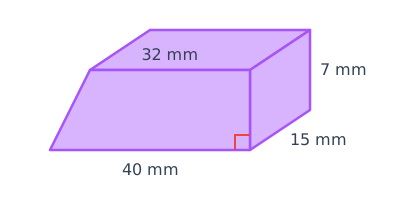
Trapezoidal Prism
cubic millimeters
Live Scratch Pad
Tri prism:
base = 40 - 32 = 8
V = ½ × 8 × 7 × 15 = 420
Rect prism:
V = 32 × 15 × 7 = 3360
Total = 420 + 3360 =  

🎓 Step-by-Step

Step 1

Break the prism into two simpler sections: a triangular prism and a rectangular prism.

8 7 15

Triangle

+
32 7 15

Rectangle

2

Current Step

Calculate the specific volume of each section.

Triangle V = ½ × base × height × depth
Rectangle V = length × width × depth

Step 3

Add the two calculated volumes together to find the total.

Live Sync Mode

Parent's Phone
Edu GUIDE
E
Emma Smith Live
Grade 7 • Mathematics • Chapter 7. Surface Area and Volume
Parent Access Michael Smith

Live Question Sync

7th Grade Math: Calculating Volume

The student is calculating the volume of a trapezoidal prism given the base dimensions and depth.
Live Sync: Student Scratch Pad
Tri prism:
base = 40 - 32 = 8
V = ½ × 8 × 7 × 15 = 420
Rect prism:
V = 32 × 15 × 7 = 3360
Total = 420 + 3360 =  
💡

Detailed Coaching Guide

Background & Formulas

While a trapezoidal prism's volume can be found using base area multiplied by depth, students commonly struggle. A highly effective alternative is decomposing the shape into two familiar 3D sections:

  • Triangular Prism: Volume = ½ × base × height × depth
  • Rectangular Prism: Volume = length × width × depth

Solution Method Assessment

Emma has successfully decomposed the shape and calculated the two separate sectional volumes! She found 420 for the triangular section and 3360 for the rectangular section.

Crucial Next Step to Coach

"She cracked it! Emma successfully added the volumes together to reach 3780. Applaud her for applying the decomposition method effectively rather than trying to memorize a complex single formula."