7th Grade Math
What is the volume of this prism?
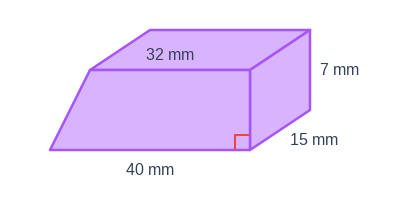
🎓 Step-by-Step
Step 1
Break the prism into two simpler sections.
Triangle
Rectangle
Current Step
Calculate the volume of each section.
Step 3
Add the two volumes together to find the total.
✏️ Live Scratchpad
Students write their work on screen, right under the problem.
🎓 Step-by-Step Hints
Hints reveal one at a time — students must think before advancing.
✅ Instant Feedback
Correct — or the worked solution in that problem's numbers. Never just "wrong".
A wrong answer opens
the solution — in this problem's numbers.
Not a generic example: the steps are computed from the question the student just missed, with the slip that usually causes it. Then one tap gives a fresh problem of the same kind to try the method on.
The student fixes it alone. You hear about it later, not during.
Not quite.
Correct answer: 3780
Answer: 3780 cubic millimeters
Watch out: Forgetting the ½ on the triangle gives 840, and a total of 4200 — the whole box, not this prism.
Write Directly on Screen
The scratchpad sits right under the problem, so the work and the question stay together — on a laptop, a tablet, or an iPad with a pencil.
Hints That Teach, Not Tell
Each hint is a guided nudge — breaking the concept into a smaller idea — so students build real understanding rather than copying steps.
A Solution in the Problem's Own Numbers
Miss a question and the steps appear with that question's numbers, the usual slip named — then "Try one like this" hands over a fresh one.
When your student needs more help — you're already ready.
Live Sync Mode mirrors what your student sees in real time and gives you a private coaching guide — full context on the problem, suggested questions to ask, and the step-by-step solution path.
Student
Parent
Ask your student to break the shape first...
Real-time · Private guide · Zero spoilers